
Indian All Old Valuable Most Rare Coins
The Anna Series
This series was introduced on 15thAugust, 1950 and represented the first coinage of Republic India. The King's Portrait was replaced by the Lion Capital of the Ashoka Pillar. A corn sheaf replaced the Tiger on the one Rupee coin. In some ways this symbolised a shift in focus to progress and prosperity. Indian motifs were incorporated on other coins. The monetary system was largely retained unchanged with one Rupee consisting of 16 Annas
| Denomination | Metal | Obverse | Reverse |
|---|---|---|---|
| Rupee One | Nickel | 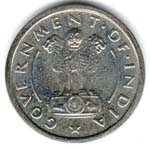 | 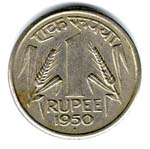 |
| Half Rupee | Nickel | 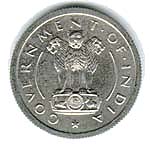 | 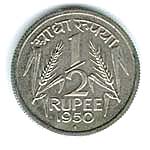 |
| Quarter Rupee | Nickel | 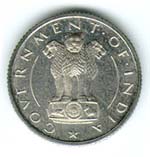 | 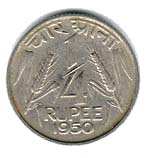 |
| Two Anna | Cupro-Nickel | 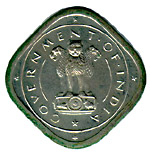 | 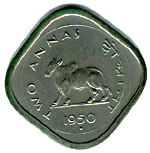 |
| One Anna | Cupro-Nickel | 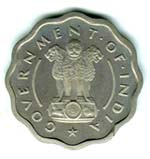 | 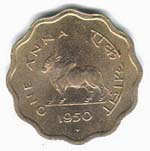 |
| Half Anna | Cupro-Nickel | 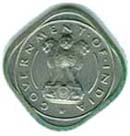 | 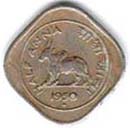 |
| One Pice | Bronze | 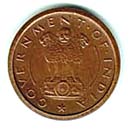 | 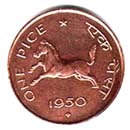 |
The Decimal Series
The move towards decimalisation was afoot for over a century. However, it was in September, 1955 that the Indian Coinage Act was amended for the country to adopt a metric system for coinage. The Act came into force with effect from 1stApril, 1957. The rupee remained unchanged in value and nomenclature. It, however, was now divided into 100 'Paisa' instead of 16 Annas or 64 Pice. For public recognition, the new decimal Paisa was termed 'Naya Paisa' till 1stJune, 1964 when the term 'Naya' was dropped.
Naya Paisa Series 1957-1964
| Denomination | Metal Weight Shape Size | Coin |
|---|---|---|
| Rupee One | Nickel 10 gms Circular 28 mm | 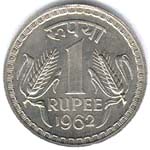 |
| Fifty Naye Paise | Nickel 5 gms Circular 24 mm | 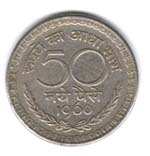 |
| Twenty Five Naye Paise | Nickel 2.5 gms Circular 19 mm | 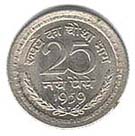 |
| Ten Naye Paise | Cupro-Nickel 5 gms Eight Scalloped 23 mm (across scallops) | 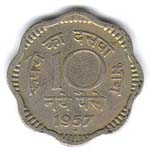 |
| Five Naye Paise | Cupro-Nickel 4 gms Square 22 mm (across corners) | 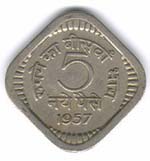 |
| Two Naye Paise | Cupro-Nickel 3 gms Eight Scalloped 18 mm (across scallops) | 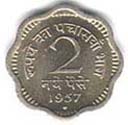 |
| One Naya Paisa | Bronze 1.5 gms Circular 16 mm | 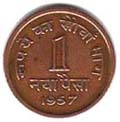 |
With commodity prices rising in the sixties, small denomination coins which were made of bronze, nickel-brass, cupro-nickel, and Aluminium-Bronze were gradually minted in Aluminium. This change commenced with the introduction of the new hexagonal 3 paise coin. A twenty paise coin was introduced in 1968 but did not gain much popularity.
Aluminium Series 1964 onwards
| Denomination | Metal Weight Shape Size | Coin |
|---|---|---|
| One Paisa | Aluminium-Magnesium 0.75 gms Square 17 mm (Daigonal) |  |
| Two Paise | Aluminium-Magnesium 1 gm Scalloped 20 mm (across scallops) | 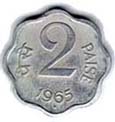 |
| Three Paise | Aluminium-Magnesium 1.25 gms Hexagonal 21 mm (Diagonal) | 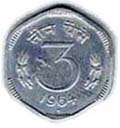 |
| Five Paise | Aluminium-Magnesium 1.5 gms Square 22 mm (Diagonal) | 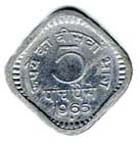 |
| Ten Paise | Aluminium-Magnesium 2.3 gms Scalloped 26 mm (across scallops) |  |
| Twenty Paise | Aluminium-Magnesium 2.2 gms Hexagonal 26 mm (diagonal) 24.5 mm (across flats) | 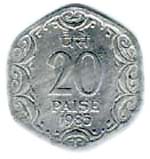 |
Over a period of time, cost benefit considerations led to the gradual discontinuance of 1, 2 and 3 paise coins in the seventies; Stainless steel coinage of 10, 25 and 50 paise, was introduced in 1988 and of one rupee in 1992. The very considerable costs of managing note issues of Re 1, Rs 2, and Rs 5 led to the gradual coinisation of these denominations in the 1990s.
Contemporary Coins
| Denomination | Metal | Weight | Diameter | Shape |
|---|---|---|---|---|
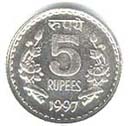 | Cupro-Nickel | 9.00 gms | 23 mm | Circular |
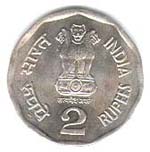 | Cupro-Nickel | 6.00 gms | 26 mm | Eleven Sided |
 | Ferratic Stainless Steel | 4.85 gms | 25 mm | Circular |
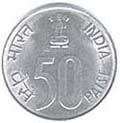 | Ferratic Stainless Steel | 3.79 gms | 22 mm | Circular |
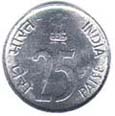 | Ferratic Stainless Steel | 2.83 gms | 19 mm | Circular |
 | Ferratic Stainless Steel | 2.00 gms | 16 mm | Circular |

No comments:
Post a Comment